Identify Edible Wild Mushrooms
Dr. MycoTek walks you through the field marks that make edible species identifiable with confidence — what to look for, what to check, and which look-alikes to rule out before you ever consider eating.
Start with a photo. No account needed until you want to save or publish your record.
Or jump into the live tools
© repta (iNaturalist, cc-by)
Why Some Species Are Safer for Beginners
The safest approach for new foragers is to start with species that have few or no dangerous look-alikes and are distinctive enough to identify with high confidence. Mycologists often recommend the 'foolproof four' (or similar regional lists) as starting species: Giant Puffball, Chicken of the Woods, Hen of the Woods/Maitake, and Morels. To this list many experienced foragers add Lion's Mane, Black Trumpets, and Oyster Mushrooms. These species share a common trait: their combination of features is distinctive enough that, when properly learned, confusion with dangerous species is unlikely. This does not mean they require no care — it means the diagnostic checks are straightforward. Every new forager should confirm their first finds with an experienced mentor.
Giant Puffball: Simple Checks, Clear Answer
The Giant Puffball (Calvatia gigantea) is often cited as the single safest wild mushroom for beginners — but only when you apply the one essential check. Slice the puffball in half from top to bottom. The interior must be uniformly pure white throughout with no visible internal structure. If you see any discolouration (yellowing means the spores are maturing and it is too old to eat), stop. If you see the outline of a developing mushroom inside — cap, gills, stem — discard it immediately. That is an Amanita egg, and it is lethal. Giant Puffballs are best when fresh and firm, sliced into steaks and fried in butter. The slice-and-check is non-negotiable: no exceptions, every time.
Chicken of the Woods: The Shelf Mushroom
Chicken of the Woods (Laetiporus sulphureus) is a bracket fungus that grows in overlapping orange-yellow shelves on hardwood trees, particularly oaks. Its bright colour, pore surface (no gills), and shelf-like growth form make it nearly unmistakable on hardwoods. Harvest young, tender specimens — the edges should still be soft and flexible. Older specimens become tough and chalky. Important caveats: avoid specimens growing on conifers (especially yew and eucalyptus), which may be a different species that causes digestive issues in more people. Approximately 10 percent of people experience mild GI discomfort from Chicken of the Woods regardless of preparation — try a small amount your first time. Cook thoroughly; never eat raw.
Chanterelles: Prized but Require One Critical Check
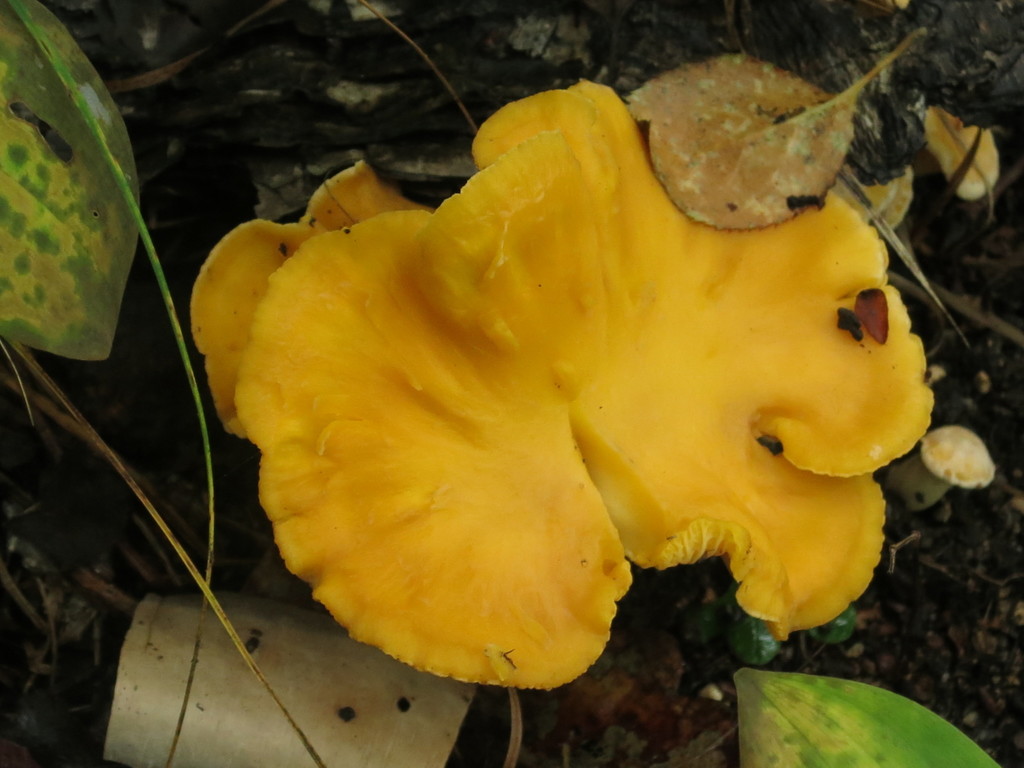
Golden chanterelles (Cantharellus cibarius and related species) are among the most prized edible wild mushrooms, with a fruity apricot aroma and peppery flavour. The critical identification feature is their false gills — blunt, forking, shallow ridges that are continuous with the cap surface and cannot be peeled away. True gills (as found on the toxic Jack O'Lantern) are blade-like and can be separated from the cap. Run your finger across the underside: chanterelle ridges feel smooth and rolling; true gills feel like sharp-edged blades with distinct gaps between them. Chanterelles also grow individually or in scattered groups from soil, while Jack O'Lanterns grow in dense clusters from wood. These two checks — false vs. true gills, and substrate — are your core confirmation.
Oyster Mushrooms: Year-Round Availability
Oyster mushrooms (Pleurotus ostreatus) are one of the most widely available wild edible mushrooms, fruiting from dead hardwood throughout most of the year. They grow in overlapping fan-shaped clusters, have white to cream decurrent gills (gills that run down the stub of a stem), and produce a white to pale lilac spore print. They have a pleasant, mild anise-like smell. The most commonly cited look-alike is the Angel Wing (Pleurocybella porrigens), a thin, white, stemless mushroom that grows on conifer wood — suspected of causing fatal encephalopathy in people with pre-existing kidney conditions. Distinguish them by substrate (oysters on hardwood, angel wings on conifers), thickness (oysters are fleshier), and gill colour (oyster gills are cream, angel wing gills are pure white).
Lion's Mane and the Hericium Family
Lion's Mane (Hericium erinaceus) is a spectacular edible mushroom that forms a single clump of cascading white spines, resembling a frozen waterfall or a white pom-pom. It grows on dead or dying hardwood, particularly beech and oak. No dangerous look-alikes exist — the other Hericium species (H. americanum, H. coralloides) have branching structures with shorter spines but are all edible. In the kitchen, it has a lobster-like texture when sliced and seared in butter until golden brown. Harvest when the spines are still white — yellowing indicates the specimen is past its prime. For beginners, Lion's Mane is valuable precisely because the diagnostic check is simple: if it has cascading white spines on hardwood, nothing dangerous looks like it.
Cooking and Preparation Safety
Even positively identified edible wild mushrooms should always be cooked before eating. Many species that are considered edible contain compounds that cause GI distress when raw but are neutralized by heat. Honey mushrooms (Armillaria) cause nausea and cramps when undercooked. Morels must be cooked; raw morels contain hydrazine derivatives. Even shiitake can cause flagellate dermatitis (an itchy skin rash) when eaten raw or undercooked. As a rule, sauté all wild mushrooms for at least 10 to 15 minutes at medium-high heat. For your first time eating any new species, consume only a small amount and wait 24 hours before eating more — individual sensitivities vary.
Sustainable Foraging Practices
Responsible foraging ensures that mushroom populations remain healthy for future generations. Leave at least one third of the fruiting bodies unharvested to allow spore dispersal. Cut mushrooms at the base with a knife rather than pulling them from the ground, which can damage the underlying mycelium. Use a mesh bag or basket (not a plastic bag) to carry your harvest — this allows spores to drop through as you walk. Never harvest from contaminated sites: roadsides, industrial areas, recently sprayed agricultural fields, or sites with known heavy metal contamination. Mushrooms bioaccumulate heavy metals and pesticides. Forage in diverse habitats rather than repeatedly harvesting the same spot, and always comply with local foraging regulations.
What You Get
See It In Action

Real photos from the community
Commercial-use Creative Commons photos from Mushroom Observer.


Frequently Asked Questions
Related Topics
Put this guide into practice
Keep a useful record while the details are fresh.
Your records stay useful on their own; AI help is optional.
Start with a photo. No account needed until you want to save or publish your record.