Identify Mushrooms by Cap Color
Tell Dr. MycoTek the cap color, habitat, and any other features you notice. Then learn what each clue actually tells a mycologist — and what to check next to narrow it down.
Start with a photo. No account needed until you want to save or publish your record.
Or jump into the live tools
© invertebratist (iNaturalist, cc-by-nc)
Why Cap Colour Is a Starting Point, Not an Answer
Cap colour is typically the first feature a forager notices, which makes it a natural starting point for identification. Experienced mycologists know, however, that colour is one of the least reliable diagnostic features in isolation. Mushroom caps change colour with age, moisture content, sun exposure, and even time of day. A cap that appears dark brown when wet may dry to a pale tan within hours. Hygrophanous species (like many Psathyrella and Conocybe) undergo dramatic colour shifts as they lose moisture. Despite these limitations, colour combined with other features — habitat, season, gill structure, spore print — becomes a powerful narrowing tool. Dr. MycoTek uses colour as the first filter in a multi-step process, then asks the questions that separate the candidates.
Red and Orange Mushrooms: What to Look for Next
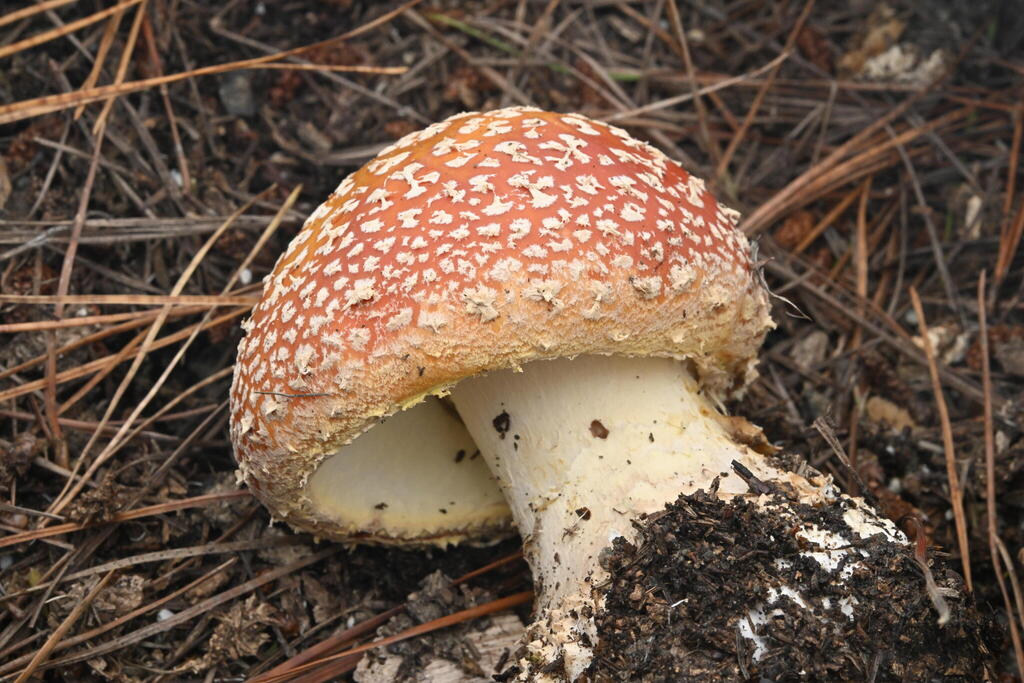
Red and orange caps include some of the most distinctive edibles and some dangerous look-alikes. The most sought-after orange mushroom is the chanterelle (Cantharellus cibarius), with its egg-yolk golden-orange cap, false gills (blunt, forking ridges rather than blade-like gills), and fruity apricot scent. Its dangerous look-alike, the Jack O'Lantern (Omphalotus olearius), has a similar orange colour but grows in dense clusters from buried wood and has true blade-like gills. Fly Agaric (Amanita muscaria) is red with white warts and is toxic. The single most important feature to check with any orange mushroom: does it have true gills or false ridges underneath? Run your finger across — true gills feel like sharp-edged blades, false ridges feel like smooth, rounded bumps.
White and Pale Mushrooms: Proceed with Maximum Care
White mushrooms demand the most caution because this group includes both common edibles and the deadliest species on the continent. White button mushrooms and field mushrooms (Agaricus) have white caps but critically have pink-to-brown gills that darken with age and produce dark brown spore prints. The Destroying Angel (Amanita bisporigera) is pure white with white gills that stay white, a ring on the stem, and a volval sac at the base — it contains lethal amatoxins. Giant puffballs are white and edible when the interior is uniformly white — always slice any round white mushroom in half. If you see the outline of a developing cap and stem inside, it is an Amanita egg, not a puffball. The diagnostic question with any white mushroom: do the gills stay white throughout its life, or do they change colour?
Brown Mushrooms: The Identification Challenge
Brown is the most common cap colour and the most difficult group to identify. This vast category includes hundreds of species ranging from prized edibles to deadly poisons. Edible brown species include porcini (Boletus edulis, with a spongy pore surface rather than gills), honey mushrooms (Armillaria, growing in clusters on wood), and chestnut mushrooms (Pholiota adiposa). Dangerous brown species include deadly Galerina (Galerina marginata), a small wood-growing mushroom with a ring on the stem and rusty-brown spore print. Brown mushrooms almost always require additional features beyond colour for a confident ID: spore print colour, gill attachment, ring presence, substrate, and habitat are all essential. Dr. MycoTek treats every brown mushroom identification as multi-step by default.
Yellow and Green Mushrooms
Yellow caps are found across several genera with dramatically different edibility profiles. Chicken of the Woods (Laetiporus sulphureus) has bright yellow-orange shelf-like brackets growing on hardwood — pore surface underneath, no gills. The toxic Sulphur Tuft (Hypholoma fasciculare) is yellow-green with gills and grows in clusters on stumps. Greenish caps are uncommon but critically important: the Death Cap (Amanita phalloides) often has a greenish-olive to yellowish-green cap, and the Green-Spored Parasol (Chlorophyllum molybdites) has a white cap with greenish tones as it matures — this is the most commonly consumed poisonous mushroom in North America. Any yellow-green mushroom warrants careful examination of gills, spore print, and stem base.
How Moisture Affects Colour Interpretation
Many mushroom species are hygrophanous, meaning their cap colour changes significantly based on moisture content. A hygrophanous cap will appear dark brown or reddish-brown when wet and fade to pale tan or whitish when dry. This colour change typically starts at the centre or margin and progresses across the surface, creating a two-toned appearance during the transition. This phenomenon is common in genera like Psathyrella, Conocybe, Kuehneromyces, and some Mycena. If a cap has two distinct colour zones, the mushroom is likely hygrophanous — photograph it wet and return an hour later to photograph it dry. Providing both images gives Dr. MycoTek much more to work with.
Using Colour With Other Features for a Reliable ID
The most effective identification strategy uses cap colour as the first filter, then narrows candidates using structural features, habitat, and spore print. A brown mushroom is impossibly broad, but a brown mushroom with pores (not gills) growing from soil near oak trees in autumn with white flesh that does not stain blue narrows the candidates to a handful of Boletus species. Similarly, an orange mushroom is ambiguous, but an orange shelf fungus with pores growing on a hardwood log is almost certainly Chicken of the Woods. Dr. MycoTek's colour-based approach works best when you also provide: what is underneath the cap, where the mushroom was growing, what trees are nearby, whether the mushroom was solitary or in clusters, and the approximate cap diameter.
What You Get
See It In Action

Real photos from the community
Commercial-use Creative Commons photos from Mushroom Observer.


Frequently Asked Questions
Related Topics
Put this guide into practice
Keep a useful record while the details are fresh.
Your records stay useful on their own; AI help is optional.
Start with a photo. No account needed until you want to save or publish your record.